
Guide
FRIA under Article 27 AI Act: who, what and by when
Public bodies, private providers of public services, credit scorers and life and health insurers must assess fundamental rights before using Annex III AI from 02.12.2027, and the draft template is open for feedback until 15.01.2027.
Key takeaways
- A FRIA is required from bodies governed by public law, private entities providing public services and any deployer using AI for credit scoring or life and health insurance pricing.
- Under the Digital Omnibus, Regulation (EU) 2026/1744, the duty applies to Annex III high-risk systems from 02.12.2027, before their first use.
- The assessment covers processes, period and frequency, affected groups, risks of harm, human oversight and measures including complaint mechanisms, and its results go to the market surveillance authority.
- Parts already covered by a DPIA under the GDPR can be cross-referenced, but the FRIA looks at all fundamental rights.
- Feedback on the AI Office draft template is open until 15.01.2027 via EUSurvey, and deployers in scope can volunteer to test it until 04.12.2026.
On this page
- Who must carry out a FRIA
- From when the duty applies
- What goes into the assessment
- Notifying the market surveillance authority
- Relationship with the DPIA under the GDPR
- The AI Office template
- Giving feedback on the draft
- Who supervises in Luxembourg
- How to prepare now
- What is still open
- Which sources does this guide use?
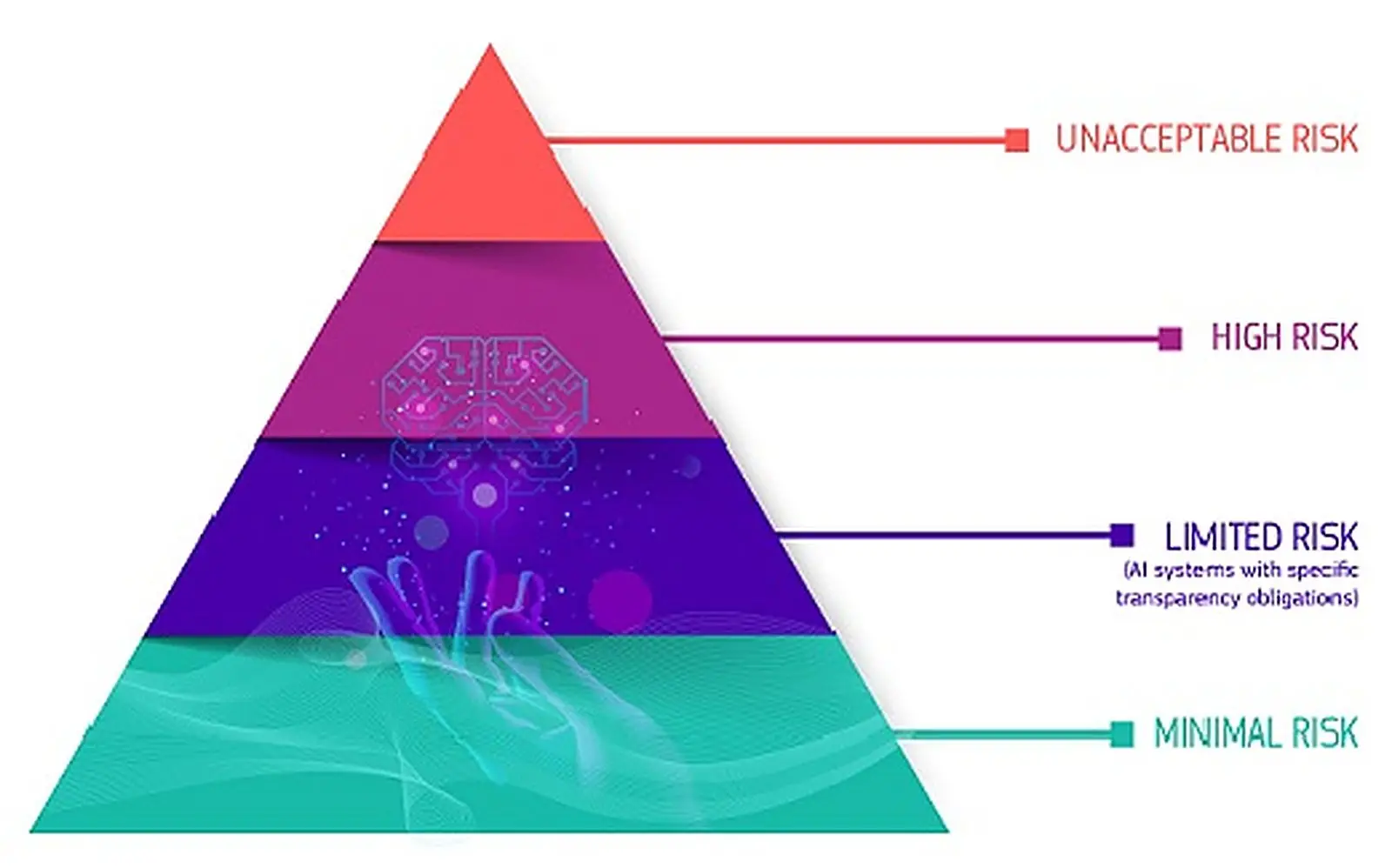
A fundamental rights impact assessment (FRIA) under Article 27 of the AI Act is required only from certain deployers: bodies governed by public law, private entities providing public services, and any business that uses AI for credit scoring or for pricing life and health insurance.
The duty applies to high-risk systems listed in Annex III from 02.12.2027. The AI Office's draft template is open for feedback until 15.01.2027, and deployers can volunteer to test it until 04.12.2026.
We checked the legal text on 19.11.2026 in the Official Journal PDF of the Digital Omnibus on AI, Regulation (EU) 2026/1744 and in the consolidated AI Act on the Commission's AI Act Service Desk (text as at 27.07.2026). EUR-Lex did not let us through on that day. The general duties of deployers, such as human oversight and logs under Article 26, are covered in our AI Act checklist for SMEs. AI literacy is in our guide on an AI policy for employees.
Who must carry out a FRIA
Article 27(1) names three groups. The duty applies before they deploy a high-risk AI system under Article 6(2), meaning a use listed in Annex III:
| Group | Which systems | Source |
|---|---|---|
| Bodies governed by public law | All Annex III areas except point 2 (critical infrastructure) | Article 27(1) |
| Private entities providing public services | All Annex III areas except point 2 | Article 27(1) |
| Any deployer, public or private | Annex III point 5(b): creditworthiness or credit score of natural persons, except AI used to detect financial fraud | Article 27(1), Annex III |
| Any deployer, public or private | Annex III point 5(c): risk assessment and pricing for natural persons in life and health insurance | Article 27(1), Annex III |
The AI Act does not define "bodies governed by public law". In its draft explanatory notice, the AI Office suggests reading the term broadly: state organs, regional and local authorities, other entities set up under public law to perform public tasks, and entities entrusted by law with public authority. For private providers of public services, the notice refers to Recital 96, which gives education, healthcare, social services, housing and the administration of justice as examples. According to the notice, these are examples, not a closed list. The notice is a draft and not an official position of the Commission.
What this means in practice: a bank or credit provider in Luxembourg that scores private customers with AI, or an insurer that prices life or health policies with AI, needs a FRIA whatever its size. A private company that only uses an AI tool to screen job applicants has a high-risk use under Annex III point 4, so it has the Article 26 duties, but Article 27 does not apply to it unless it provides public services. Whether a private school, clinic or care home counts as a "private entity providing public services" will depend on the final guidance and, in the end, on the courts. We mark this as open.
From when the duty applies
The Digital Omnibus on AI, Regulation (EU) 2026/1744 of 08.07.2026 (Official Journal of 24.07.2026), moved the high-risk dates. The new Article 113, point (c)(i), applies Chapter III, Sections 1 to 3, which include Article 27, from 02.12.2027 to systems classified as high-risk under Annex III. The Commission's consultation page confirms that deployers must comply "as of 2 December 2027".
Two details matter for planning:
- First use. Under Article 27(2), the FRIA is due before the first use of the system. If something listed in paragraph 1 changes during use, you update it. According to the draft notice, a new version of the system or of its underlying model can count as such a change.
- Systems already in use. Under Article 111(2), high-risk systems placed on the market or put into service before 02.12.2027 are covered only if their design changes significantly afterwards. Providers and deployers of high-risk systems intended for use by public authorities must comply by 02.08.2030 in any case.
Weekly, Thursday morning, Central European Time.
The Thinking briefing
One email a week: what changed in European business software, which prices moved, and which comparison we published. No sales mail.
What goes into the assessment
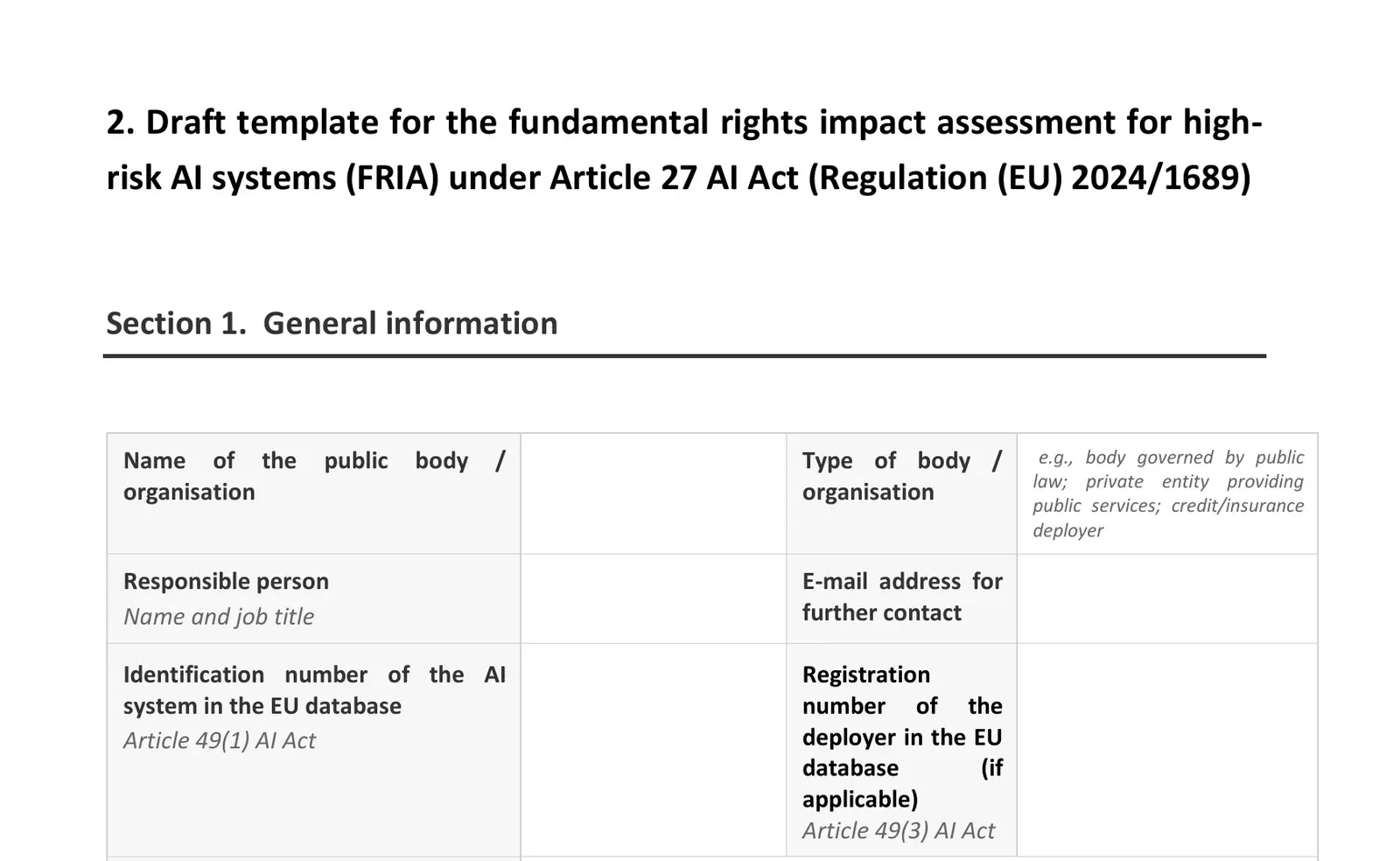
Article 27(1), points (a) to (f), sets the content. The AI Office draft template follows this structure:
| Article 27(1) | Content | Draft template |
|---|---|---|
| (a) | Your processes in which the system is used in line with its intended purpose | Section 2, question 2.1 |
| (b) | Period of time and frequency of use | Section 2, question 2.2 |
| (c) | Categories of people and groups likely to be affected | Section 3 |
| (d) | Specific risks of harm to these groups, using the provider's information under Article 13 | Section 4 |
| (e) | How human oversight is implemented according to the instructions for use | Section 5 |
| (f) | Measures if risks materialise, including internal governance and complaint mechanisms | Section 6 |
On top of that, the draft has a Section 1 with general details (organisation, responsible person, EU database numbers, area of use, reliance on earlier assessments, stakeholders consulted) and a Section 7 with an overall conclusion.
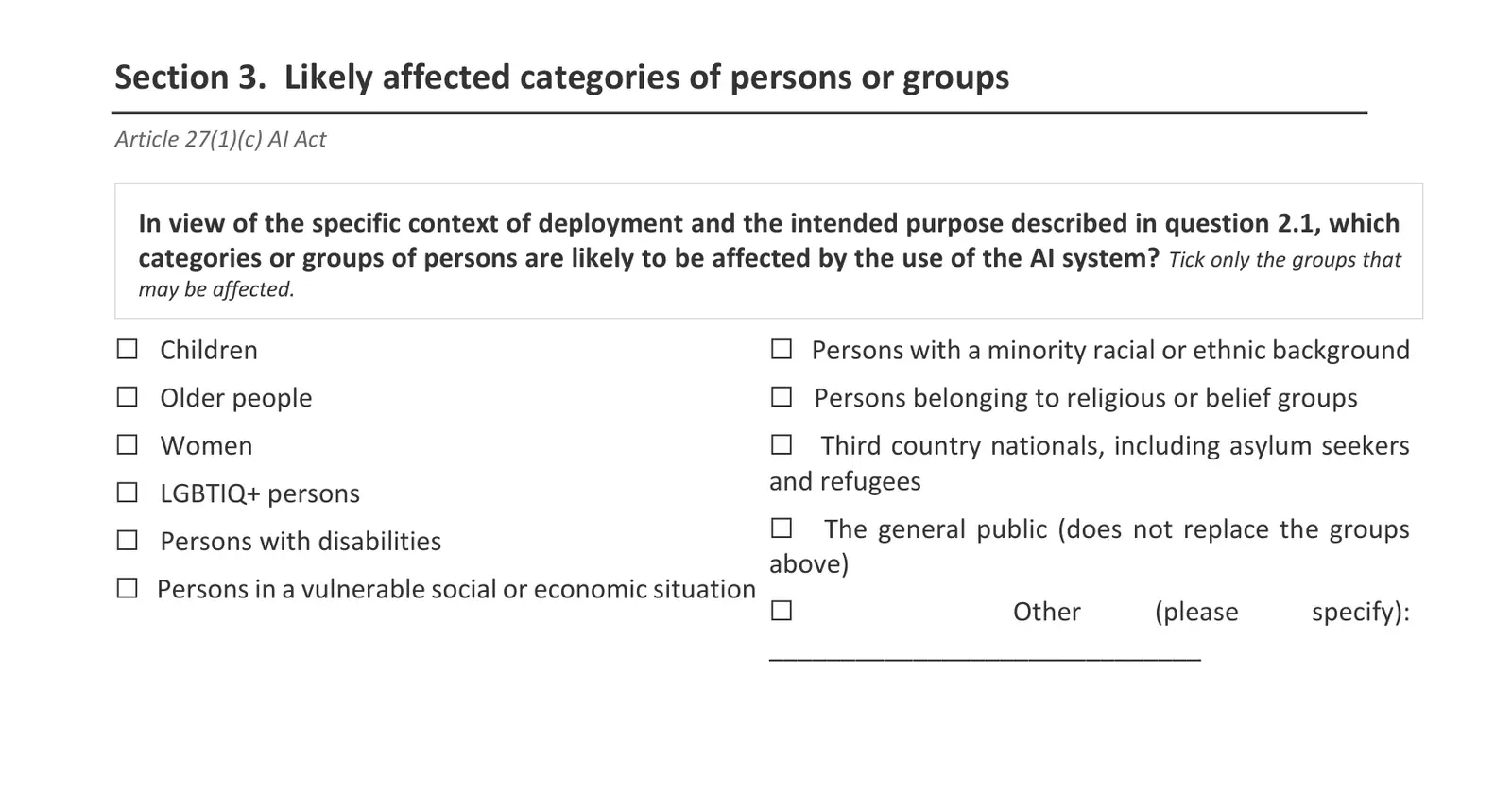
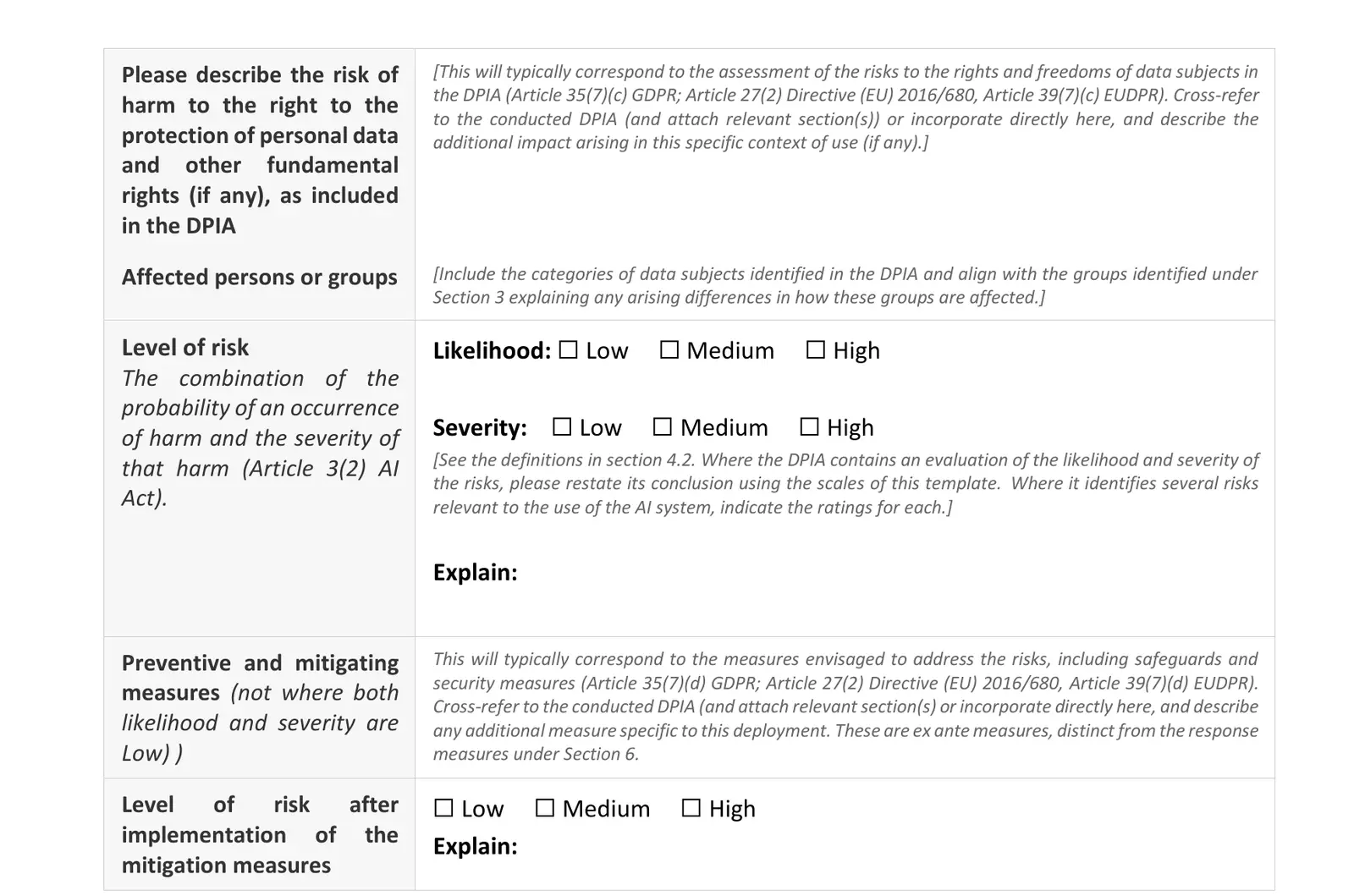
In Section 4, the draft asks for each risk which fundamental rights are affected, how likely and how severe the harm is (Low, Medium or High), which preventive measures you take and what risk remains afterwards. The right to data protection gets its own block, which can be filled in from an existing data protection impact assessment.
According to the draft notice, a FRIA is needed for every AI system and covers all its purposes of use. The AI Office recommends a multidisciplinary team, clear responsibility for the final assessment, the provider's instructions for use and, where appropriate, input from affected people, independent experts or civil society.
Notifying the market surveillance authority
Once the assessment is done, Article 27(3) requires you to notify the results to the market surveillance authority and to attach the completed template. Only in the case of Article 46(1), an exceptional authorisation for example for reasons of public security, can deployers be exempt from notifying. According to the draft notice, this exemption covers the notification only, not the assessment.
The channel is not set yet: in the draft, the place where the notification link should go still reads "[link to be added later]". Public authorities that register the use of a high-risk system in the EU database under Article 49(3) also fill in a summary of the findings. That summary is published in the public part of the database.
Relationship with the DPIA under the GDPR
Many FRIA deployers will already have a data protection impact assessment (DPIA) under Article 35 GDPR for the same system. Article 26(9) tells them to use the provider's information for it. Article 27(4), in the wording of the Omnibus, lets you include cross-references to the relevant sections of the DPIA in the FRIA or copy the relevant parts.
The two assessments do not replace each other. According to the draft notice, the DPIA looks at the risks of processing personal data, while the FRIA covers all fundamental rights that the use may affect. The draft lists, among others, equality and non-discrimination, the rights of the child, workers' rights and access to healthcare.
The AI Office template
Under Article 27(5), as amended by the Omnibus, the AI Office develops a questionnaire template, including an automated tool, to simplify compliance. The template must allow cross-references to the DPIA. According to the Commission, the current draft was prepared with input from the EU Agency for Fundamental Rights (FRA). Once adopted, deployers will have to use it for the notification, and it will be offered as an automated tool on the AI Act Single Information Platform. The draft's cover page states that the Commission has not adopted or endorsed it.
Giving feedback on the draft
The Commission published the consultation on 16.11.2026 on its Shaping Europe's digital future site. It has two parts:
1. Public consultation on the template, until 15.01.2027.
- Form: EUSurvey questionnaire "Stakeholder consultation on the draft template for a fundamental rights impact assessment under Article 27 AI Act", in English only.
- Who can take part: organisations (companies, associations, authorities, civil society, research) and individuals in a personal capacity, such as independent experts. Deployers, providers and other operators can choose their stakeholder category.
- Structure: questions on the explanatory notice and on each section of the template. You can answer only some sections or questions.
- Publication: contributions may be published. You can choose whether your name is published with them. The form asks you not to put personal data in the contribution itself. The AI Office will publish an aggregated summary without direct quotes.
2. Testing the template in practice, expression of interest until 04.12.2026.
- For deployers that will themselves have to carry out a FRIA under Article 27: EUSurvey form "FRIA template testing: expression of interest", about five minutes according to the form.
- Participants apply the draft to one of their own systems, planned or in use. The AI Office supports them with an introductory session, answers along the way and a closing session.
- If there are many applications, the AI Office selects for a balanced mix of areas of use, Member States and organisation sizes. Participation is voluntary and does not change any obligation under the AI Act.
Before you open the form, read the draft notice and template (PDF) and collect comments from legal, data protection and the business unit.
Who supervises in Luxembourg
The market surveillance authority that receives the notification is not yet designated by law in Luxembourg. Bill No. 8476, filed on 23.12.2024, would implement the AI Act. On 19.11.2026, the Chamber of Deputies still listed it as "En commission", last updated on 10.07.2026. According to the CNPD, the bill would make the CNPD the default market surveillance authority and give it a role for fundamental rights, alongside ALIA and the ITM.
For financial institutions, Article 74(6) of the AI Act provides that the financial supervisor is the market surveillance authority, as far as the use is directly connected with the financial services. The title of bill 8476 also lists changes to the CSSF law and to the law on the insurance sector. How tasks will finally be split between the CNPD, the CSSF and the CAA depends on the law as passed. We mark this as open.
How to prepare now
- Check whether you are in scope. Are you a public body, do you provide public services, or do you use AI for credit scoring or life and health insurance pricing? If none applies, document why and stop here.
- List your Annex III uses. Use the inventory from our AI Act checklist and mark which systems fall under Article 27.
- Ask the provider in writing for the instructions for use and for the information under Article 13, and ask whether an impact assessment exists that you could rely on under Article 27(2). According to the draft notice, providers do not have to share it, but sharing is good practice.
- Start from your DPIA. Where a DPIA exists, note which parts can be cross-referenced and which rights it does not cover.
- Set up the team. Name a person responsible for the final assessment and bring together legal, data protection, IT and the business unit.
- Name the human oversight staff. Article 26(2) requires competence, training, authority and support. Describe who can stop or override the system.
- Set up a complaint channel. Point (f) asks for complaint mechanisms and internal governance if a risk materialises.
- Test the draft on one system. If you are in scope, the testing call until 04.12.2026 gives you direct support from the AI Office.
- Plan the dates. The FRIA must be ready before first use, so build it into every project that goes live after 02.12.2027.
What is still open
- The final template, the automated tool and the notification channel are not published yet. The draft can still change after the consultation.
- Bill 8476 has not been passed. The Luxembourg market surveillance authority for FRIA notifications and the split between CNPD, CSSF and CAA are not final.
- The meaning of "private entities providing public services" is only described in a draft notice and in Recital 96.
- The AI Act sets no deadline in days for the notification. Article 27(3) only says it follows once the assessment has been performed.
Which sources does this guide use?
All sources accessed on 19.11.2026.
- European Commission: consultation on the draft FRIA template (16.11.2026), draft explanatory notice and template (PDF), EUSurvey consultation, EUSurvey testing form, legal notice (CC BY 4.0)
- Official Journal: Regulation (EU) 2026/1744, Digital Omnibus on AI (OJ L of 24.07.2026, PDF via the EU Publications Office)
- AI Act Service Desk, consolidated text as at 27.07.2026: Article 26, Article 27, Article 46, Article 49, Article 74, Article 111, Article 113, Annex III, Recital 96
- Luxembourg: Bill No. 8476, Chamber of Deputies; CNPD, Un an déjà pour le règlement européen sur l'intelligence artificielle (18.08.2025)
Questions and answers
Does every company using high-risk AI need a FRIA?
From when is the FRIA mandatory?
How can I comment on the draft FRIA template?
Sources
- [1] Commission seeks feedback on draft template for the fundamental rights impact assessment under the AI Act, Shaping Europe's digital future (16.11.2026) accessed 2026-11-19
- [2] Draft Explanatory Notice and template for the fundamental rights impact assessment under Article 27(5) of Regulation (EU) 2024/1689 (AI Office, PDF) accessed 2026-11-19
- [3] EUSurvey: Stakeholder consultation on the draft template for a fundamental rights impact assessment under Article 27 AI Act accessed 2026-11-19
- [4] EUSurvey: FRIA template testing, expression of interest accessed 2026-11-19
- [5] Regulation (EU) 2026/1744 of 8 July 2026 (Digital Omnibus on AI), Official Journal L, 24.07.2026 (PDF via EU Publications Office) accessed 2026-11-19
- [6] Article 27: Fundamental rights impact assessment for high-risk AI systems, AI Act Service Desk (consolidated text as at 27.07.2026) accessed 2026-11-19
- [7] Article 113: Entry into force and application, AI Act Service Desk accessed 2026-11-19
- [8] Article 111: AI systems already placed on the market or put into service, AI Act Service Desk accessed 2026-11-19
- [9] Annex III: High-risk AI systems referred to in Article 6(2), AI Act Service Desk accessed 2026-11-19
- [10] Recital 96, AI Act Service Desk accessed 2026-11-19
- [11] Article 26: Obligations of deployers of high-risk AI systems, AI Act Service Desk accessed 2026-11-19
- [12] Article 46: Derogation from conformity assessment procedure, AI Act Service Desk accessed 2026-11-19
- [13] Article 49: Registration, AI Act Service Desk accessed 2026-11-19
- [14] Article 74: Market surveillance and control of AI systems in the Union market, AI Act Service Desk accessed 2026-11-19
- [15] Projet de loi 8476, Chambre des Députés accessed 2026-11-19
- [16] Un an déjà pour le règlement européen sur l'intelligence artificielle, CNPD (18.08.2025) accessed 2026-11-19
- [17] Legal notice, Shaping Europe's digital future accessed 2026-11-19