


Guide
AI Act checklist for Luxembourg SMEs using AI
A Luxembourg SME that uses AI tools must already avoid prohibited practices and meet the Article 50 transparency duties, while the high-risk duties of Article 26 apply from 02.12.2027.
Key takeaways
- A business that only uses AI tools is a deployer; it becomes a provider if it rebrands, substantially modifies or repurposes a system into a high-risk use.
- Prohibited practices such as emotion recognition at work have been banned since 02.02.2025, and two further bans apply from 02.12.2026.
- Since 02.08.2026, deployers must disclose deepfakes, certain AI texts on matters of public interest and the use of emotion recognition or biometric categorisation.
- Deployer duties for Annex III high-risk systems, such as recruitment tools, apply from 02.12.2027, including human oversight, logs kept at least six months and informing workers.
- Luxembourg's implementing bill No. 8476, which would make the CNPD the default AI authority, was still in committee on 13.11.2026.
On this page
- Which AI Act deadlines apply to deployers?
- Step 1: Are you a deployer or a provider?
- Step 2: How do you classify the AI tools you use?
- Step 3: Have you ruled out prohibited practices?
- Step 4: Which transparency duties does Article 50 give deployers?
- Step 5: Is one of your tools high-risk under Annex III?
- Step 6: How do you prepare the Article 26 duties now?
- Step 7: Do you need a fundamental rights impact assessment?
- Who will supervise the AI Act in Luxembourg?
- What if you develop your own AI system?
- Checklist: what should a deployer do now?
- What is still open?
A Luxembourg SME that only uses AI tools is a deployer under the AI Act, and three duties already apply to it: no prohibited AI practices, transparency in the cases of Article 50, and AI literacy for staff.
The heavier deployer obligations for high-risk AI, such as human oversight, log retention and informing workers, apply from 02.12.2027 for the systems listed in Annex III. This checklist shows what to check now and what to prepare.
We checked every date and article on 13.11.2026 against the consolidated AI Act on the Commission's AI Act Service Desk (text as at 27.07.2026, including the Digital Omnibus on AI), CNPD pages and the file of the Chamber of Deputies. AI literacy under Article 4 is covered in our guide on writing an AI policy for employees and is not repeated here.
Which AI Act deadlines apply to deployers?
| Date | What applies | Legal basis |
|---|---|---|
| 02.02.2025 | Prohibited practices (Article 5) and AI literacy (Article 4) | Article 113, point (a) |
| 02.08.2025 | Penalty chapter of the AI Act | Article 113, point (b) |
| 02.08.2026 | Transparency obligations of Article 50, general application | Article 113 |
| 02.12.2026 | Two new prohibitions: non-consensual intimate deepfakes and child sexual abuse material | Article 113, point (a) |
| 02.12.2027 | High-risk obligations for Annex III systems, including Articles 26 and 27 | Article 113, point (c)(i) |
| 02.08.2028 | High-risk obligations for AI in products under Annex I | Article 113, point (c)(ii) |
Step 1: Are you a deployer or a provider?
Article 3(4) defines a deployer as any person or body "using an AI system under its authority", except for personal, non-professional use. A provider develops an AI system, or has one developed, and places it on the market or puts it into service under its own name. A bakery using ChatGPT for menus, a fiduciary using an AI tool to read invoices or a shop with a chatbot from an outside vendor are deployers.
The role can change. Under Article 25, you become the provider of a high-risk AI system and take on the provider obligations of Article 16 if you:
- put your name or trademark on a high-risk system already on the market,
- make a substantial modification to a high-risk system so that it remains high-risk, or
- change the intended purpose of a system, including a general-purpose AI system, so that it becomes high-risk.
Practical example: if you configure a general chatbot to rank job applicants, you change its purpose into a use listed in Annex III. Check this before you build anything of your own on top of a model.
Weekly, Thursday morning, Central European Time.
The Thinking briefing
One email a week: what changed in European business software, which prices moved, and which comparison we published. No sales mail.
Step 2: How do you classify the AI tools you use?
Take your tool inventory (step 1 of our AI policy guide) and add one column: the risk class. The AI Act knows four levels.
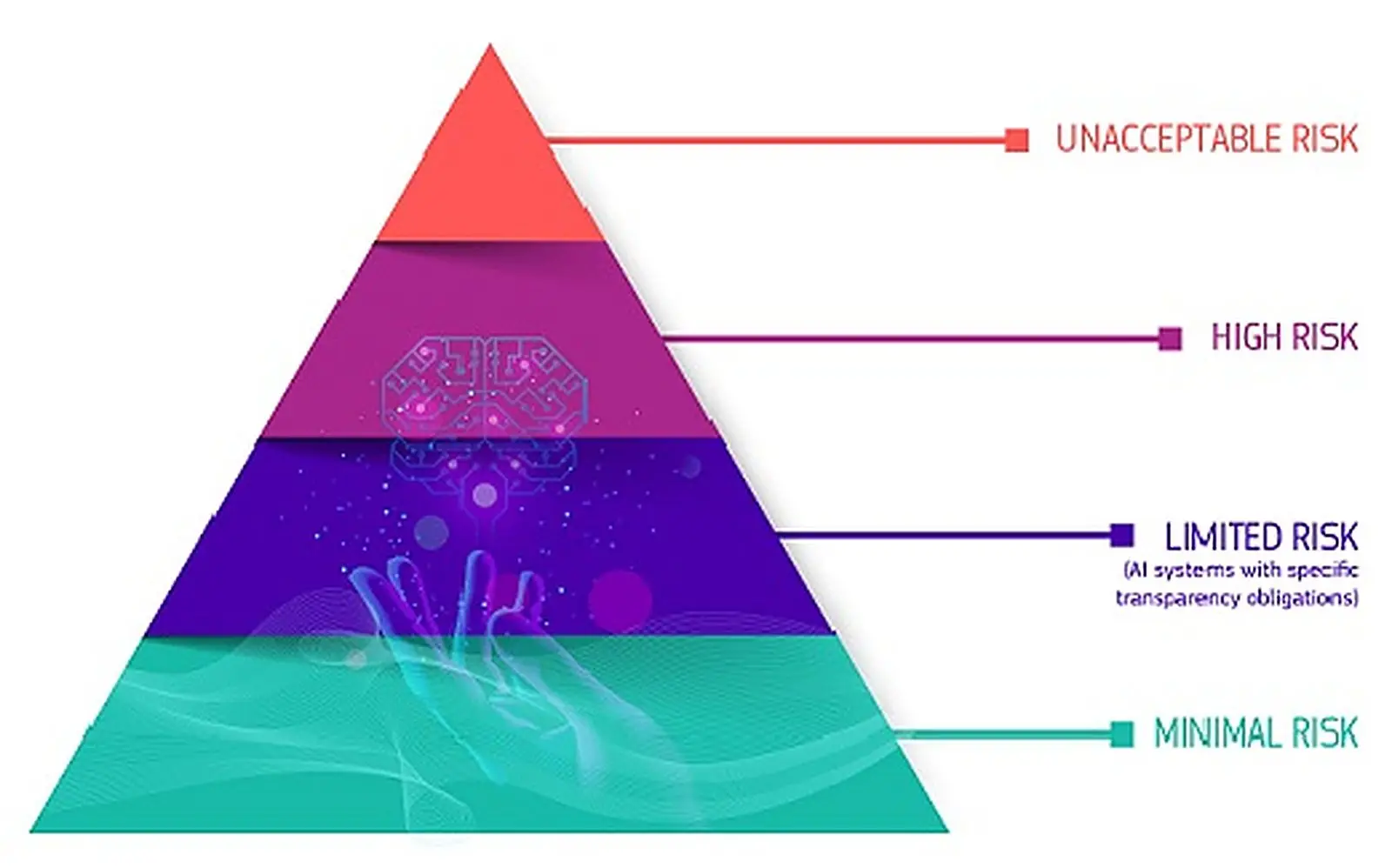
For each tool, answer four questions: Is the use prohibited (step 3)? Does it trigger an Article 50 duty (step 4)? Is it listed in Annex III (step 5)? If none applies, the AI Act adds no specific duty for that tool beyond AI literacy, but the GDPR still applies to any personal data.
Step 3: Have you ruled out prohibited practices?
Prohibitions have applied since 02.02.2025 and bind deployers too, because Article 5 bans not only placing such systems on the market but also their "use". For an SME, the most relevant are:
- Emotion recognition at work (Article 5(1)(f)), except for medical or safety reasons. The CNPD gives the example of systems that analyse facial expressions, tone of voice or gestures of employees to measure engagement, satisfaction or stress.
- Manipulative techniques and exploiting vulnerabilities due to age, disability or a social or economic situation, where they cause or are likely to cause significant harm.
- Social scoring that leads to detrimental or unfavourable treatment.
- Biometric categorisation that infers sensitive traits such as political opinions or sexual orientation.
From 02.12.2026, Article 5(1)(ba) and (bb) also prohibit AI that generates realistic intimate images of identifiable people without their explicit consent, and AI that generates child sexual abuse material. For deployers, the use is prohibited where the system is used for that purpose (Article 5(1a)(b)).
The CNPD stresses that it can act on most prohibited practices under the GDPR already, through complaints or investigations, independently of its future role under the AI Act. Fines for prohibited practices go up to 35 million euros or 7 % of worldwide annual turnover; for SMEs, Article 99(6) sets the lower of the two amounts as the ceiling.
Step 4: Which transparency duties does Article 50 give deployers?
Since 02.08.2026, Article 50 obliges deployers to:
- inform people exposed to an emotion recognition or biometric categorisation system that it is operating (Article 50(3)),
- disclose deepfakes as artificially generated or manipulated (Article 50(4)),
- disclose AI-generated text on matters of public interest, unless a person reviewed it and holds editorial responsibility (Article 50(4)).
The information must be clear and distinguishable at the latest at the first interaction or exposure (Article 50(5)). Labelling in practice, with the EU icons, is explained in our AI policy guide. The Commission has published guidelines on Article 50; for transparency duties other than marking and labelling, deployers may choose adequate measures themselves in light of the guidelines. Breaches of Article 50 can cost up to 15 million euros or 3 % of turnover, again capped at the lower amount for SMEs.
Step 5: Is one of your tools high-risk under Annex III?
Annex III lists the use cases. For SMEs, these are the ones to look for:
- Recruitment and selection (point 4(a)): targeted job ads, filtering applications, evaluating candidates.
- Decisions about staff (point 4(b)): promotion, termination, allocating tasks based on behaviour or personal traits, monitoring and evaluating performance.
- Creditworthiness of natural persons (point 5(b)), except fraud detection.
- Risk assessment and pricing in life and health insurance (point 5(c)).
- Education and training (point 3): admission, evaluating learning outcomes, monitoring exams.
- Biometrics (point 1), including emotion recognition where it is not prohibited.
These obligations apply from 02.12.2027. For high-risk systems placed on the market or put into service before that date, Article 111(2) applies the rules only if the system's design changes significantly afterwards. Ask your vendor in writing how it classifies its product and how it plans to comply.
Step 6: How do you prepare the Article 26 duties now?
If a tool is high-risk, Article 26 will require you, from 02.12.2027, to:
- use it in line with the provider's instructions for use, with technical and organisational measures,
- assign human oversight to people with the necessary competence, training, authority and support,
- ensure input data is relevant and sufficiently representative, where you control it,
- monitor operation, inform the provider and suspend use if the system presents a risk; report serious incidents immediately to the provider, then to the importer or distributor and the market surveillance authority,
- keep the automatically generated logs under your control for at least six months,
- inform workers' representatives and affected workers before using the system at the workplace,
- inform people that they are subject to a high-risk system when it makes or assists decisions about them,
- use the provider's information for your GDPR data protection impact assessment, where one is required.
Under Article 86, people affected by a decision based on an Annex III system that has legal or similarly significant effects can ask you for a clear explanation of the AI's role. Breaches of Article 26 can lead to fines up to 15 million euros or 3 % of turnover, capped at the lower amount for SMEs.
Step 7: Do you need a fundamental rights impact assessment?
Most private SMEs do not. Article 27 requires it before deploying a high-risk system for bodies governed by public law, private entities providing public services, and deployers of systems for credit scoring (Annex III, 5(b)) or life and health insurance pricing (5(c)). The assessment describes the process, period and frequency of use, affected groups, specific risks, human oversight and remedies, and its results are notified to the market surveillance authority. The AI Office is to provide a template; parts already covered by a GDPR impact assessment can be cross-referenced.
Who will supervise the AI Act in Luxembourg?
Bill No. 8476 would make the CNPD the default market surveillance authority, single point of contact and operator of the national AI regulatory sandbox, according to the CNPD. For fundamental rights, it would share tasks with ALIA and the ITM; sector regulators such as the CSSF and the CAA keep their fields. The bill also defines national penalties. On 13.11.2026, the Chamber of Deputies still listed the bill as "en commission", last updated 10.07.2026.

What if you develop your own AI system?
Then you are a provider, and an AI regulatory sandbox may help. Implementing Regulation (EU) 2026/2487, published in the Official Journal on 11.11.2026, sets common rules: providers apply, deployers may join an application as partners, regulatory services are free for SMEs and the decision comes within three months. Our news piece on EU rules for AI sandboxes explains the details. The CNPD's application page, last updated 15.01.2026, announced submissions to its AI sandbox for August 2026; on 13.11.2026 we found no published call on the CNPD pages. To exchange with regulators in the meantime, the RE.M.I. community of the CNPD and the AI Factory is open; see our report on its new AI agent governance working group.
Checklist: what should a deployer do now?
- Role checked: deployer, or provider under Article 25?
- Inventory with a risk class for every AI tool?
- Prohibited practices ruled out, including emotion recognition at work?
- Article 50 cases identified and disclosure in place?
- Annex III tools marked and vendors asked in writing?
- Owner named for human oversight, logs and incident reporting of high-risk tools?
- Workers' representatives informed before any high-risk use at work?
- Need for a fundamental rights impact assessment checked?
What is still open?
- Bill No. 8476 has not been passed. The competent Luxembourg authority and the national penalty rules are therefore not final.
- No call for the CNPD's AI sandbox under the AI Act was published on the pages we checked on 13.11.2026.
- EUR-Lex blocked our access on 13.11.2026. We used the AI Act Service Desk consolidated text as at 27.07.2026 and the Official Journal PDF of Regulation (EU) 2026/2487 from the EU Publications Office.
- We have not checked whether the AI Office template for Article 27 has been published.
- This guide is not legal advice. Have high-risk cases checked individually.
Questions and answers
Is an SME that only uses ChatGPT covered by the AI Act?
When do the high-risk obligations for deployers apply?
Who enforces the AI Act in Luxembourg?
Sources
- [1] Article 113: Entry into force and application, AI Act Service Desk (consolidated text as at 27.07.2026) accessed 2026-11-13
- [2] Article 3: Definitions, AI Act Service Desk accessed 2026-11-13
- [3] Article 5: Prohibited AI practices, AI Act Service Desk accessed 2026-11-13
- [4] Article 25: Responsibilities along the AI value chain, AI Act Service Desk accessed 2026-11-13
- [5] Article 26: Obligations of deployers of high-risk AI systems, AI Act Service Desk accessed 2026-11-13
- [6] Article 27: Fundamental rights impact assessment for high-risk AI systems, AI Act Service Desk accessed 2026-11-13
- [7] Article 50: Transparency obligations for providers and deployers of certain AI systems, AI Act Service Desk accessed 2026-11-13
- [8] Article 86: Right to explanation of individual decision-making, AI Act Service Desk accessed 2026-11-13
- [9] Article 99: Penalties, AI Act Service Desk accessed 2026-11-13
- [10] Article 111: AI systems already placed on the market or put into service, AI Act Service Desk accessed 2026-11-13
- [11] Annex III: High-risk AI systems referred to in Article 6(2), AI Act Service Desk accessed 2026-11-13
- [12] Guidelines on transparency obligations for providers and deployers of certain AI systems, European Commission accessed 2026-11-13
- [13] Commission Implementing Regulation (EU) 2026/2487 of 10 November 2026 on AI regulatory sandboxes, Official Journal L, 11.11.2026 (PDF via EU Publications Office) accessed 2026-11-13
- [14] Les systèmes d'IA prohibés selon l'AI Act : impact sur la protection des données personnelles, CNPD accessed 2026-11-13
- [15] Un an déjà pour le règlement européen sur l'intelligence artificielle, CNPD (18.08.2025) accessed 2026-11-13
- [16] Projet de loi 8476, Chambre des Députés accessed 2026-11-13
- [17] Sandkëscht, soumettre un projet, CNPD accessed 2026-11-13
- [18] L'AI Act en action, de la politique à la pratique, gouvernement.lu (20.01.2026) accessed 2026-11-13
- [19] Aspects légaux, gouvernement.lu accessed 2026-11-13
- [20] Legal notice, Shaping Europe's digital future accessed 2026-11-13