
Guide
AI fraud in SMEs: 10 rules against deepfakes and CEO fraud
An SME fends off voice clones, deepfake calls, CEO fraud and fake IBANs mainly with fixed procedures: call back on a known number, a second approval, no account changes by email, and in an emergency the bank, evidence and a police complaint straight away.
Key takeaways
- According to Europol, criminals use voice deepfakes to make CEO fraud and BEC more credible, and ENISA found phishing to be the most common way in, at about 60 % of cases.
- A familiar voice, a known face or a displayed number is no proof, because numbers can be spoofed and voices cloned from existing recordings.
- The best protection is fixed procedures: call back on a number from your own records, a second person for every approval and no IBAN change based on an email or invoice alone.
- Since 09.10.2025, banks in the euro area check free of charge whether the payee's name matches the IBAN, and a warning from this check should stop a payment.
- In an emergency, call the bank at once, secure the evidence and file a complaint with the Grand Ducal Police, while private-sector IT incidents go to CIRCL.
On this page
- What AI changes
- Four schemes and their warning signs
- A cloned voice on the phone
- A deepfake in a video call
- How CEO fraud works
- Fake invoices and changed bank details
- Overview: scheme, warning sign, countermeasure
- The procedures that actually protect you
- Training: what your team needs to know
- In an emergency: step by step
- Where to report in Luxembourg
- Checklist: 10 rules against AI fraud
- What is still open
- Which sources does this guide use?
AI makes old fraud schemes against businesses far more convincing: voices can be cloned, video calls faked and emails written without a single mistake. An SME can still protect itself, with fixed procedures rather than gut feeling.
The key rules: call back on a number you already hold, never let one person release a payment alone, never change bank details on request, and train your team regularly.
If money is already on its way, every minute counts. Call your bank straight away, secure all evidence and file a complaint with the Grand Ducal Police. For IT incidents, CIRCL can help as well.
For this guide we relied only on official sources, all checked on 19.11.2026: the Grand Ducal Police, CIRCL, GOVCERT.LU, BEE SECURE, the CSSF, ENISA and Europol. We also used a circular from the Ministry of Home Affairs, a statement by the Luxembourg public prosecutor, the media regulator ALIA and the European Commission. How to train staff on AI in general is covered in our guide to an AI policy for employees. Emergency contacts and reporting duties for IT outages are in our Microsoft 365 outage emergency plan. For an example of AI being used against IT systems themselves, see our news report on the AI-driven cyber campaign against the European Commission.
What AI changes
The schemes themselves are not new. What is new is how real they look. In its threat assessment IOCTA 2025, Europol writes that criminals use voice deepfakes to make spear-phishing campaigns for CEO fraud and business email compromise (BEC) more credible. Large language models help them tailor messages to the victim's language and circumstances.
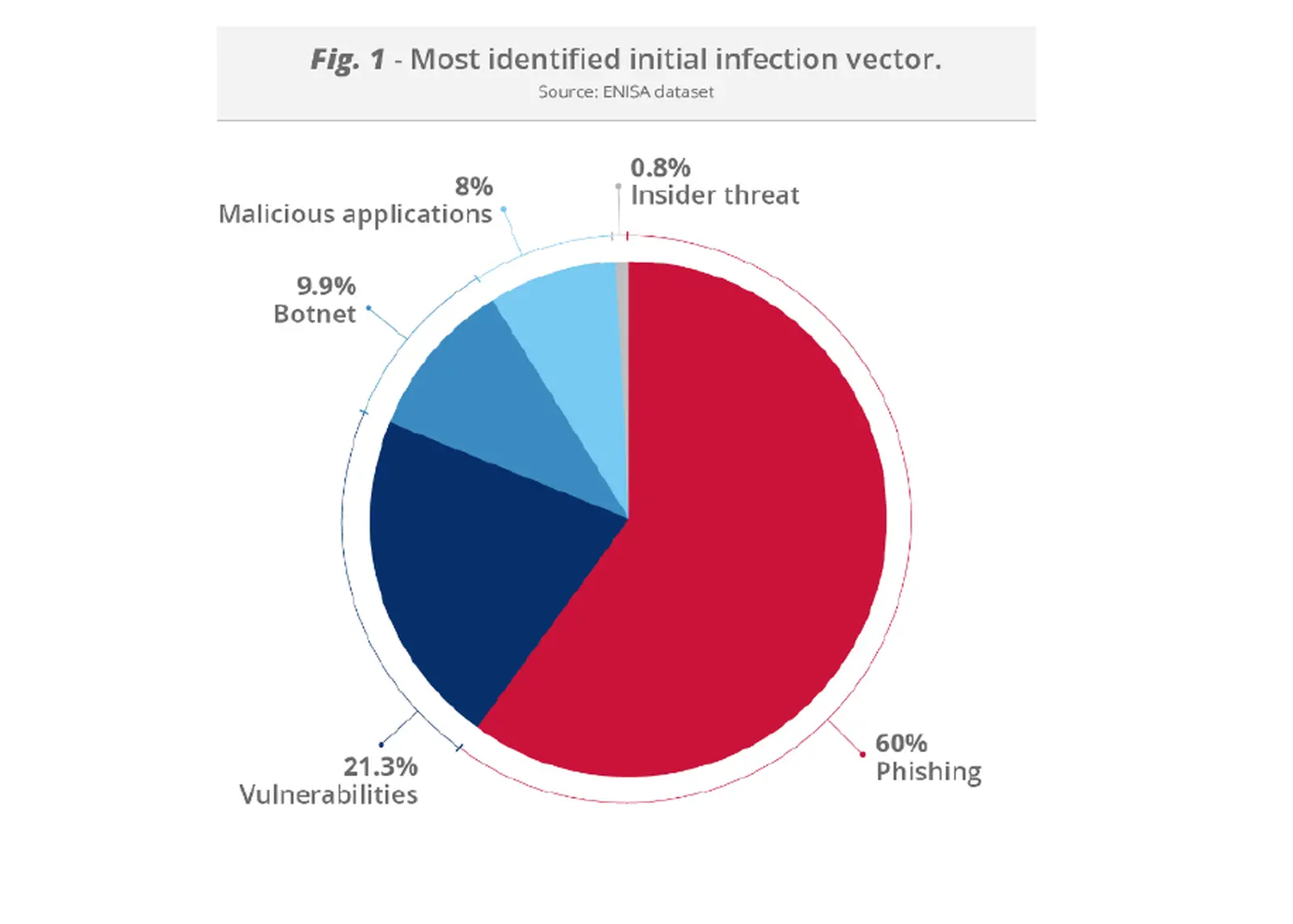
The EU cybersecurity agency ENISA paints a similar picture in the ENISA Threat Landscape 2025. In its dataset, phishing, including vishing by phone, was the most common way in, at about 60 % of observed cases. Citing industry data, ENISA also reports that over 80 % of phishing emails identified between September 2024 and February 2025 used AI in some form. According to ENISA, AI is also used in vishing and in impersonation fraud, including deepfakes.
Official reports show how expensive this can get:
- In its Spotlight report Online fraud schemes (2023), Europol describes a case in which criminals used deepfake audio to impersonate a company's CEO and obtained a transfer worth the equivalent of 35 Mio. EUR.
- Luxembourg's media regulator ALIA describes in its deepfake dossier (12.01.2026) a case from Hong Kong in early 2024. An employee transferred 23 Mio. EUR after fraudsters used AI to stage an entire video conference with his manager and the company's board.
- In Luxembourg, the public prosecutor stated on 06.08.2024 that the fraudulent transfers at Caritas were, in all likelihood, linked to the scheme known as CEO fraud. The investigation is ongoing and the presumption of innocence applies. The prosecutor did not mention any role of AI.
- On 13.10.2026, the Ministry of Home Affairs warned municipalities about CEO fraud and fake transfer orders in circular 2026-085. Its recommendations work for SMEs too, and we use them below.
Four schemes and their warning signs
A cloned voice on the phone
A voice clone can be built from existing recordings, for example from videos or social media posts. BEE SECURE makes this point in a post from 12.10.2026. A familiar voice therefore proves nothing about who is really speaking. Nor does the number on the screen: the Grand Ducal Police warns about caller ID spoofing, which lets fraudsters display any number they like.
Warning signs according to BEE SECURE, the police and the EU financial supervisors' leaflet on AI fraud, published by the CSSF:
- a call from an unknown number, with an excuse for why the usual one cannot be used
- strong time pressure and an urgent request for money or data
- a request to tell no one, or not to hang up
- an intonation that sounds unnatural, too smooth or robotic, although the leaflet notes that AI voices can also sound very natural
A deepfake in a video call
According to the EU supervisors' leaflet, lip movements and facial expressions in fake videos may not match the speech, and the background, lighting and shadows may be inconsistent. In its report Facing reality? Law enforcement and the challenge of deepfakes, Europol lists further flaws: blurring around the edges of the face, a lack of blinking, light reflections in the eyes and inconsistencies in hair or scars.
Do not rely on these. ALIA writes that reliable visual or audio flaws are becoming rarer because the models keep improving. Often only the context helps: does the request fit the person, the channel and your procedures? Europol advises organisations not to rely on detection software alone, but to make the whole authorisation process more robust.
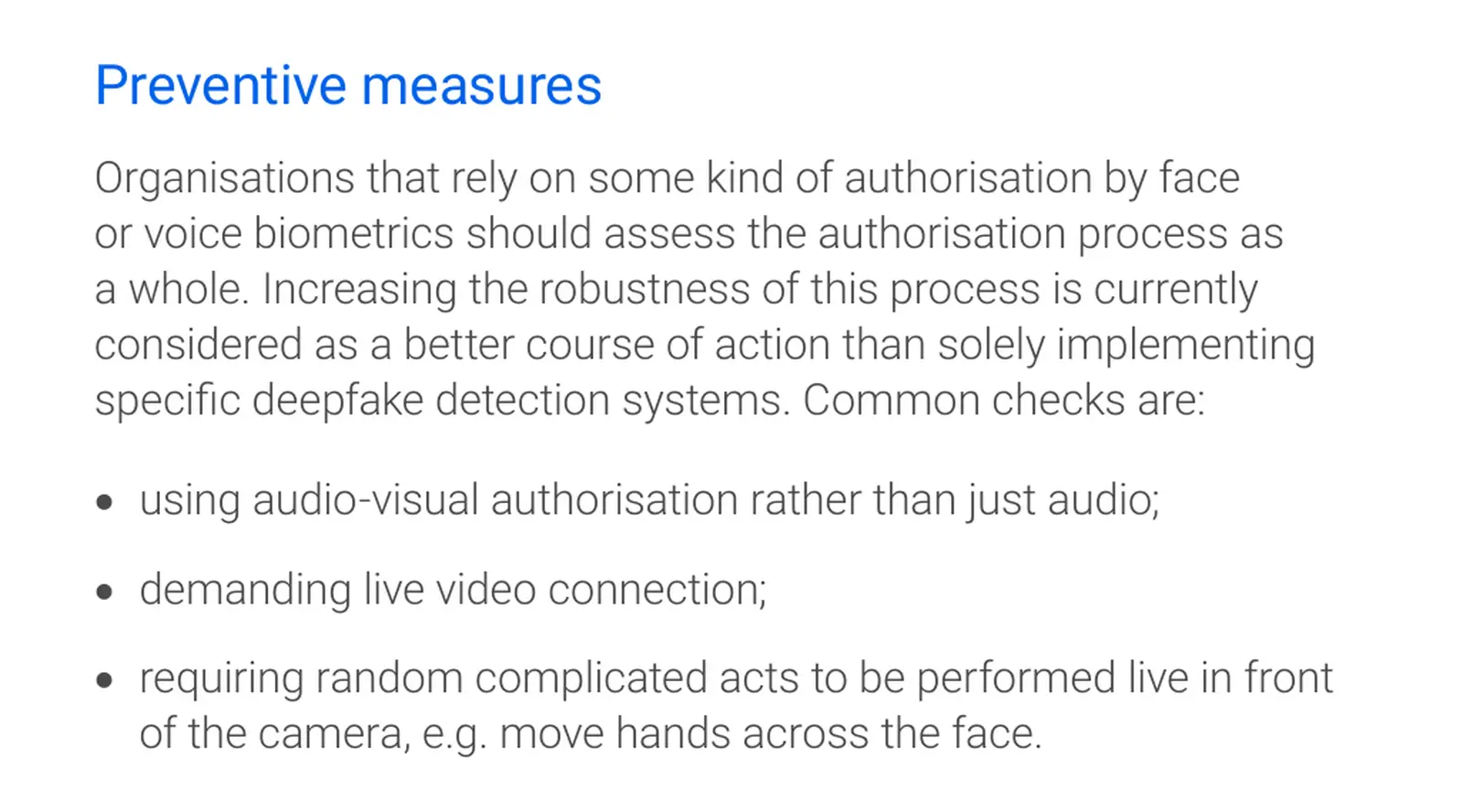
The checks listed there, such as live video or random actions in front of the camera, refer to biometric authorisation by face or voice. For payments in an SME, calling back on a known channel remains the more important step, as explained below.
How CEO fraud works
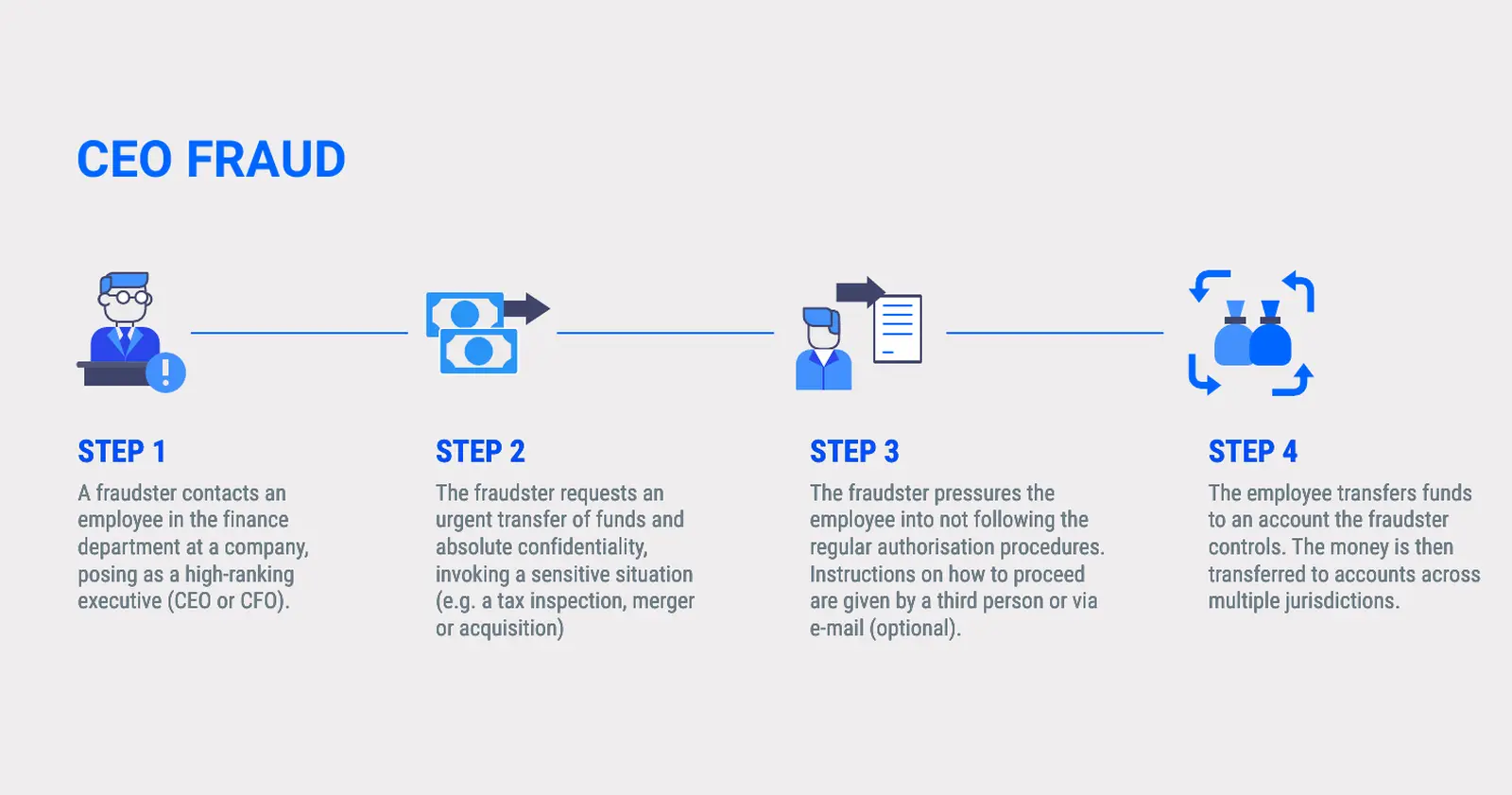
In CEO fraud, according to the Grand Ducal Police, a fraudster poses as the boss or as a trusted service provider. He first gathers information about the company so he can answer questions. He then demands absolute confidentiality and an urgent payment to another account, usually abroad.
Europol's CEO fraud factsheet lists these warning signs:
- an unsolicited call or email
- direct contact from a senior official you do not normally deal with
- a request for absolute confidentiality
- pressure and a sense of urgency
- an unusual request that contradicts internal procedures
- threats, unusual flattery or promises of reward
- a reference to a sensitive situation such as a tax inspection, a merger or an acquisition
- further instructions that are to follow later from a third person or by email
Fake invoices and changed bank details
In invoice fraud, Europol explains, someone poses as a supplier, service provider or creditor and asks for future invoices to be paid into a new account. That account belongs to the fraudster. The approach can come by phone, letter or email. In its Spotlight report, Europol describes how criminals illicitly gain access to a company's email. Besides invented invoices, they also use genuine invoices in which the supplier's bank details have been altered.
The ministry's circular names two related variants: a notice that a supplier's bank details have supposedly changed, and a fake IT technician who wants to carry out maintenance on the payment system.
Warning signs are a new IBAN with no plausible reason, a change announced only by email or on the invoice itself, and pressure to pay today. The circular calls for extra care during school holidays, on public holidays, on Friday evenings, at weekends and when staff are standing in for colleagues.
Weekly, Thursday morning, Central European Time.
The Thinking briefing
One email a week: what changed in European business software, which prices moved, and which comparison we published. No sales mail.
Overview: scheme, warning sign, countermeasure
| Scheme | Typical warning sign | Main countermeasure | Source |
|---|---|---|---|
| Cloned voice | familiar voice, unknown number, urgency | hang up and call back on the known number | BEE SECURE, police |
| Deepfake video call | request for payment or data during the call | approval only through the normal process, never in the call | Europol, ALIA |
| CEO fraud | confidentiality, pressure, bypassing procedures | no exceptions, check with a second person | police, Europol |
| Invoice with new IBAN | account change by email or on the invoice | call the supplier back on a number from your own records | Ministry of Home Affairs, Europol |
The procedures that actually protect you
All official sources rely on fixed procedures. An SME can introduce these steps without much effort:
- Call back on a known number. Never call the number given by the caller, the email or the letter. The circular requires a call back on a number from an existing, reliable source in your own files. Europol advises using contact details from previous correspondence. This applies even when the boss's voice on the phone sounds genuine.
- No payment by one person alone. The circular recommends multiple checks for payments abroad and at home. Europol advises employees who have doubts about a transfer order to consult a competent colleague, even if they were asked to be discreet. In practice: one person enters the payment, a second releases it, and the second person makes the call back.
- Never change bank details on request. According to the circular, new bank details must never be accepted on the basis of an email, an invoice or another document alone. You need a call back to the supplier and a bank account confirmation issued by the bank. If the change concerns an open invoice, the supplier should send a new invoice.
- Take payee verification seriously. Since 09.10.2025, payment service providers in the euro area must check free of charge whether the payee's name matches the IBAN, according to the European Commission (Verification of Payee). If your bank shows a mismatch or only a partial match, the circular says the payment should not be released. Confirm the details through a verified channel instead.
- No exceptions under pressure. The Grand Ducal Police advises always following the security procedures for payments, never skipping a step and not giving in to pressure. Write into your rules that this also applies to instructions from management.
- Offer a smaller target. Europol recommends reviewing what your company website reveals and being careful with information about hierarchy, procedures, contracts and suppliers, including on social media. The circular mentions travel plans, overly detailed organisation charts and accounting information.
- Confirm after paying. Europol suggests sending the payee an email after each paid invoice that names the bank and the last four digits of the account. For regular suppliers, Europol recommends designated single points of contact and, above a certain threshold, an extra confirmation of the account.
- Keep technology up to date. The circular mentions up-to-date security systems, proper management of access rights and supervising external technicians. The EU supervisors' leaflet recommends strong, unique passwords and multi-factor authentication.
What about a code word? BEE SECURE and the EU financial supervisors recommend agreeing on a secret word in advance, but for families, as an extra safeguard against voice clones. BEE SECURE stresses that it must not be the only check and that you should never say it first during a suspicious call. In the official sources we checked, we found no such recommendation specifically for companies. If you introduce one internally anyway, use it only in addition to the call back.
Training: what your team needs to know
Europol advises companies to be aware of the risks and make sure employees are too, to treat payment requests with caution and to set up reporting routines for fraud attempts. The circular recommends regular awareness sessions for all staff, especially those who process invoices and release payments.
Training against AI fraud should cover at least:
- the four schemes in this guide and their warning signs
- why a familiar voice, a known face or a displayed number is no proof
- your internal rules: call back, second approval, no account changes by email
- whom to report a suspicion to, and that false alarms are welcome
- what to do in an emergency, and in which order
Europol also advises employees to always report suspicious emails or calls to IT and to check sender addresses carefully. According to Europol's page Take control of your digital life, fraudsters often use copycat addresses where only one character differs from the original.
In an emergency: step by step
- Call your bank immediately. Use your bank's official channel. If the payment has not gone out yet, have it stopped. If it has, the circular says to ask for the funds to be blocked or returned. The Grand Ducal Police advises asking the bank to freeze the account temporarily, to refund unlawful transactions and to block any WERO account. According to the European Commission, instant transfers arrive within seconds, so every minute counts.
- Stop further payments. Identify all affected transfers and pending payment orders, and block the fraudulent bank details in your accounting system.
- Block cards and access. According to the police, you can block bank and credit cards through Worldline on (+352) 49 10 10 and a LuxTrust account on (+352) 24 550 550. Change your passwords and your security questions.
- Secure the evidence. Keep emails, messages, phone numbers, names, web addresses and transfer receipts. The police asks you to bring all of it when you file the complaint.
- Contain any IT incident. If a fraudster had access to a computer, the police says to disconnect it from the internet immediately. CIRCL advises disconnecting systems from the network rather than switching them off, deleting nothing and noting every step with the time and time zone.
- File a complaint. You file it at a police station or directly with the public prosecutor. The police's online complaint form only covers certain thefts, not fraud. According to the circular, a quick complaint improves the chances of getting the money back.
- Report attempts too. Europol and the police advise reporting failed attempts as well, so that others can be warned.
- Beware of the second scam. The EU supervisors' leaflet warns about so-called recovery rooms: fraudsters pose as an authority and offer to recover the lost money for a fee.
Where to report in Luxembourg
| Body | What for | Contact | Source |
|---|---|---|---|
| Grand Ducal Police | complaint, also for attempts | emergency number 113; Luxembourg police station around the clock on (+352) 244 40 1000 | Police |
| Public prosecutor | complaint can also be filed directly | see the police page on complaints | Police |
| Your bank | stop the payment, recall, freeze the account | the bank's official channel | Police, circular |
| Worldline | block bank and credit cards | (+352) 49 10 10 | Police |
| LuxTrust | block access | (+352) 24 550 550 | Police |
| CIRCL | IT incidents in the private sector, municipalities and non-governmental organisations | info@circl.lu, emergency line (+352) 247 88444; phishing links via LookyLoo |
CIRCL |
| GOVCERT.LU | incidents at government bodies and critical operators | report form on the website | GOVCERT.LU |
| CSSF | if a financial firm is involved or someone acts in the CSSF's name | warnings on the CSSF website | CSSF |
| BEE SECURE Helpline | confidential advice, mainly for private individuals | 8002 1234 (only from Luxembourg networks) | BEE SECURE |
Two notes. CIRCL says that if you intend to file a criminal complaint, you should contact the police first. The CSSF states that it never asks companies for payment through its Director General and that its email addresses always end in @cssf.lu. Whether a fraud case is also a reportable NIS2 incident for you depends on your sector. The basics are in our Microsoft 365 emergency plan.
Checklist: 10 rules against AI fraud
- Payments and account changes only through the fixed process, never during a call or video call.
- Always call back on a number from your own records.
- Every payment needs a second person to release it.
- A new IBAN only with a call back and a bank confirmation, never on the basis of an email or invoice alone.
- Never click away a payee verification warning.
- Confidentiality and urgency are a reason to check, not to speed up.
- Publish fewer details about hierarchy, procedures and suppliers.
- Train your team regularly, especially accounting and assistants.
- Keep the emergency numbers of your bank, the police, Worldline and CIRCL at hand.
- Report every attempt internally and to the police.
What is still open
- We found no official figures on AI-assisted fraud against companies in Luxembourg.
- Whether and how fast a bank can recall an instant transfer is not answered by the sources we checked. Ask your bank about its emergency route in advance.
- The cases of 35 Mio. EUR and 23 Mio. EUR come from Europol and ALIA reports, and we could not verify them ourselves. The Caritas investigation is still ongoing.
- Signs for spotting deepfakes date quickly. ALIA warns that obvious flaws are disappearing.
Which sources does this guide use?
All sources accessed on 19.11.2026.
- Grand Ducal Police: CEO fraud (as of 26.10.2026), help for scam victims, fake calls, filing a complaint, online complaint, Luxembourg police station
- Ministry of Home Affairs: circular 2026-085 on CEO fraud and fake transfer orders (13.10.2026)
- Luxembourg public prosecutor: statement in the Caritas case (06.08.2024)
- CIRCL: report an incident, contact, mission
- GOVCERT.LU: home page and report form
- BEE SECURE: voice cloning on the phone (12.10.2026), Helpline
- CSSF: EU financial supervisors' leaflet on fraud in the age of AI (EBA, EIOPA, ESMA, 2025), warning about persons misusing the CSSF's name (15.03.2024), warnings
- ALIA: deepfake dossier (12.01.2026)
- ENISA: ENISA Threat Landscape 2025 (October 2025, CC BY 4.0)
- Europol: IOCTA 2025, Spotlight Online fraud schemes (2023), Facing reality? Deepfakes (2022, 2024 version), CEO fraud factsheet, invoice fraud factsheet, Take control of your digital life (updated 18.02.2026)
- European Commission: new rules on instant payments and payee verification (10.10.2025)
Questions and answers
How can I tell a cloned voice on the phone?
What do I do if we have already paid the fraudsters?
Where do I report a fraud attempt in Luxembourg?
Sources
- [1] Arnaque au président, Police grand-ducale (mise à jour 26.10.2026) accessed 2026-11-19
- [2] Arnaques, Aide aux victimes, Police grand-ducale (mise à jour 16.11.2026) accessed 2026-11-19
- [3] Faux appels, Police grand-ducale accessed 2026-11-19
- [4] Porter plainte, démarches à suivre, Police grand-ducale accessed 2026-11-19
- [5] Dépôt d'une plainte en ligne, E-Commissariat, Police grand-ducale accessed 2026-11-19
- [6] Commissariat Luxembourg, Police grand-ducale accessed 2026-11-19
- [7] Fiche Europol fraude au président (FR), publiée par la Police grand-ducale accessed 2026-11-19
- [8] Circulaire 2026-085: Vigilance par rapport aux escroqueries dites « au président » ou Fovi, Ministère des Affaires intérieures (13.10.2026) accessed 2026-11-19
- [9] Communiqué du parquet de Luxembourg dans l'affaire dite « Caritas » (06.08.2024) accessed 2026-11-19
- [10] Get help from CIRCL, report an incident accessed 2026-11-19
- [11] CIRCL contact accessed 2026-11-19
- [12] CIRCL mission accessed 2026-11-19
- [13] GOVCERT.LU accessed 2026-11-19
- [14] Arnaque au téléphone : quand la voix de votre enfant est imitée par l'IA, BEE SECURE (12.10.2026) accessed 2026-11-19
- [15] BEE SECURE Helpline accessed 2026-11-19
- [16] Fraudes financières et escroqueries en ligne à l'ère de l'intelligence artificielle (EBA, EIOPA, ESMA factsheet, 2025, published by the CSSF) accessed 2026-11-19
- [17] Warning concerning persons misusing the name of the CSSF (15.03.2024) accessed 2026-11-19
- [18] Warnings, CSSF accessed 2026-11-19
- [19] Dossier Deepfakes, ALIA (12.01.2026) accessed 2026-11-19
- [20] ENISA Threat Landscape 2025 (October 2025) accessed 2026-11-19
- [21] IOCTA 2025: Steal, deal and repeat, Europol accessed 2026-11-19
- [22] Online fraud schemes: a web of deceit, Europol Spotlight Report (2023) accessed 2026-11-19
- [23] Facing reality? Law enforcement and the challenge of deepfakes, Europol Innovation Lab (2022, version 2024) accessed 2026-11-19
- [24] CEO/Business Email Compromise (BEC) fraud factsheet, Europol #CyberScams accessed 2026-11-19
- [25] Invoice fraud factsheet, Europol #CyberScams accessed 2026-11-19
- [26] Take control of your digital life, Europol (updated 18.02.2026) accessed 2026-11-19
- [27] New EU rules make instant euro payments faster and safer, European Commission (10.10.2025) accessed 2026-11-19