
Guide
Labelling AI content: Article 50 AI Act for SMEs
The AI Act's transparency duties have applied since 02.08.2026: chatbots must reveal they are AI, deepfakes and unreviewed AI texts on public matters need a notice. Deadlines, examples for websites, social media and customer service, and a checklist.
Key takeaways
- Article 50 AI Act has applied since 02.08.2026; the Digital Omnibus (Regulation (EU) 2026/1744) only gives providers of existing generative systems until 02.12.2026 for machine-readable marking.
- Chatbots and voicebots must reveal they are AI at first contact; a notice only in the terms or the word assistant is not enough.
- Deepfakes need a visible or audible notice; according to the Commission that includes an AI video of your own CEO and an embellished AI product image.
- AI texts only need a label if they inform the public on matters of public interest and no human has reviewed them and taken responsibility.
- In Luxembourg, bill 8476 would put ALIA and the CNPD in charge of supervision; the law has not yet been passed.
On this page
- Which deadlines apply to Article 50?
- Step 1: Are you a provider or a deployer?
- Step 2: Disclose chatbots and voicebots as AI
- Step 3: Check whether an image, video or audio is a deepfake
- Step 4: Art, satire, fiction need only a lighter notice
- Step 5: Label AI texts only on matters of public interest
- Step 6: What a good notice looks like
- Step 7: Sign the code or prove it yourself?
- Step 8: Who supervises in Luxembourg?
- Checklist: labelling AI content correctly
- What is still open
Since 02.08.2026 the transparency duties in Article 50 of the AI Act apply. For an SME this means: a chatbot must say it is AI, deepfakes need a visible notice, and so do AI texts on matters of public interest that no human has reviewed.
Ordinary ad copy and product descriptions written with AI are not covered by the legal labelling duty. Machine-readable marking is a job for the tool providers, and for systems already on the market before 02.08.2026 only from 02.12.2026.
We checked every point on 20.11.2026 against official sources: the Official Journal of the EU, the consolidated text in the Commission's AI Act Service Desk, the AI Office's guidelines and code of practice, and pages from ALIA, CNPD and ILNAS. Your other duties as a deployer are in our AI Act checklist for SMEs, and when a fundamental rights impact assessment is needed in our FRIA guide. We show the EU labelling icons in step 4 of our guide to an AI policy for employees. How fraudsters use deepfakes against companies is explained in our guide to AI fraud in SMEs, and how one platform wants to detect them in our news piece on TikTok's Likeness Detection.
Which deadlines apply to Article 50?
The Digital Omnibus on AI, Regulation (EU) 2026/1744 of 08.07.2026, was published in the Official Journal of the EU, L series, on 24.07.2026 and has applied since 27.07.2026. It does not postpone Article 50. It only gives providers of existing systems more time for marking.
| Date | What applies | Legal basis |
|---|---|---|
| 02.08.2026 | Article 50(1) to (6) apply: chatbot disclosure, marking, emotion recognition, deepfakes, AI texts | Article 113, second paragraph, AI Act, unchanged |
| 02.08.2026 | No transitional period for the chatbot disclosure, not even for existing systems | Commission guidelines, paragraph 153 |
| 02.12.2026 | Marking duty (paragraph 2) for generative systems placed on the market before 02.08.2026 | new Article 111(4), inserted by Art. 1 point 39(b) Regulation (EU) 2026/1744, OJ L 24.07.2026, p. 35 |
| 02.12.2026 | New bans on non-consensual intimate deepfakes and child sexual abuse material | Article 113, third paragraph, point (a) as amended by Art. 1 point 40 Regulation (EU) 2026/1744, p. 35 |
The Omnibus also rewrote Article 50(7) (Art. 1 point 20, p. 22): the Commission assesses the code of practice itself and adopts an implementing act only if it finds the code inadequate.
Deepfakes generated before 02.08.2026 and AI texts published before that date need no retroactive label, although the Commission encourages labelling older deepfakes. An AI text created earlier but published on or after 02.08.2026 does need the notice (guidelines, paragraph 154).
Step 1: Are you a provider or a deployer?
Article 50 splits the duties between two roles.
- Providers develop an AI system or have it developed and place it on the market or put it into service under their own name (Article 3(3)). They handle the chatbot disclosure (paragraph 1) and machine-readable marking (paragraph 2).
- Deployers use an AI system under their authority, except for purely personal use (Article 3(4)). They label deepfakes and certain texts (paragraph 4) and inform people about emotion recognition (paragraph 3).
The Commission guidelines show where the line runs for companies. A company that develops a chatbot in-house and uses it under its own name is a provider. A company that modifies an existing generative system, for example with new training data, and runs it under its own name also becomes a provider. Employees are not separate deployers, and your company stays the deployer when freelancers operate the tool on its behalf and under its control. A company that merely commissions an ad agency, without deciding whether and how the agency uses AI, is not a deployer. Individuals act professionally as soon as they gain a regular economic benefit or work freelance.
Weekly, Thursday morning, Central European Time.
The Thinking briefing
One email a week: what changed in European business software, which prices moved, and which comparison we published. No sales mail.
Step 2: Disclose chatbots and voicebots as AI
A system falls under paragraph 1 if it is an AI system and interacts directly with people in both directions. Classic out-of-office replies and rule-based quick answers do not count. If your service team drafts replies with AI help and sends them itself, that is not direct interaction. If AI replies go out without genuine human review, that part needs the notice.
The guidelines read the exception for "obvious" AI narrowly. An internal assistant for trained staff can qualify. A chatbot on your website or helpdesk whose answers customers could mistake for a human's expressly does not.
According to the guidelines, suitable techniques include:
- a clearly visible notice in plain language and a first chat message naming the AI, possibly with a persistent label next to the input field,
- on the phone, a spoken sentence at the start ("You are speaking with an AI assistant"), with reminders in long calls,
- for AI agents that write emails or book appointments, a notice that they are AI and on whose behalf they act.
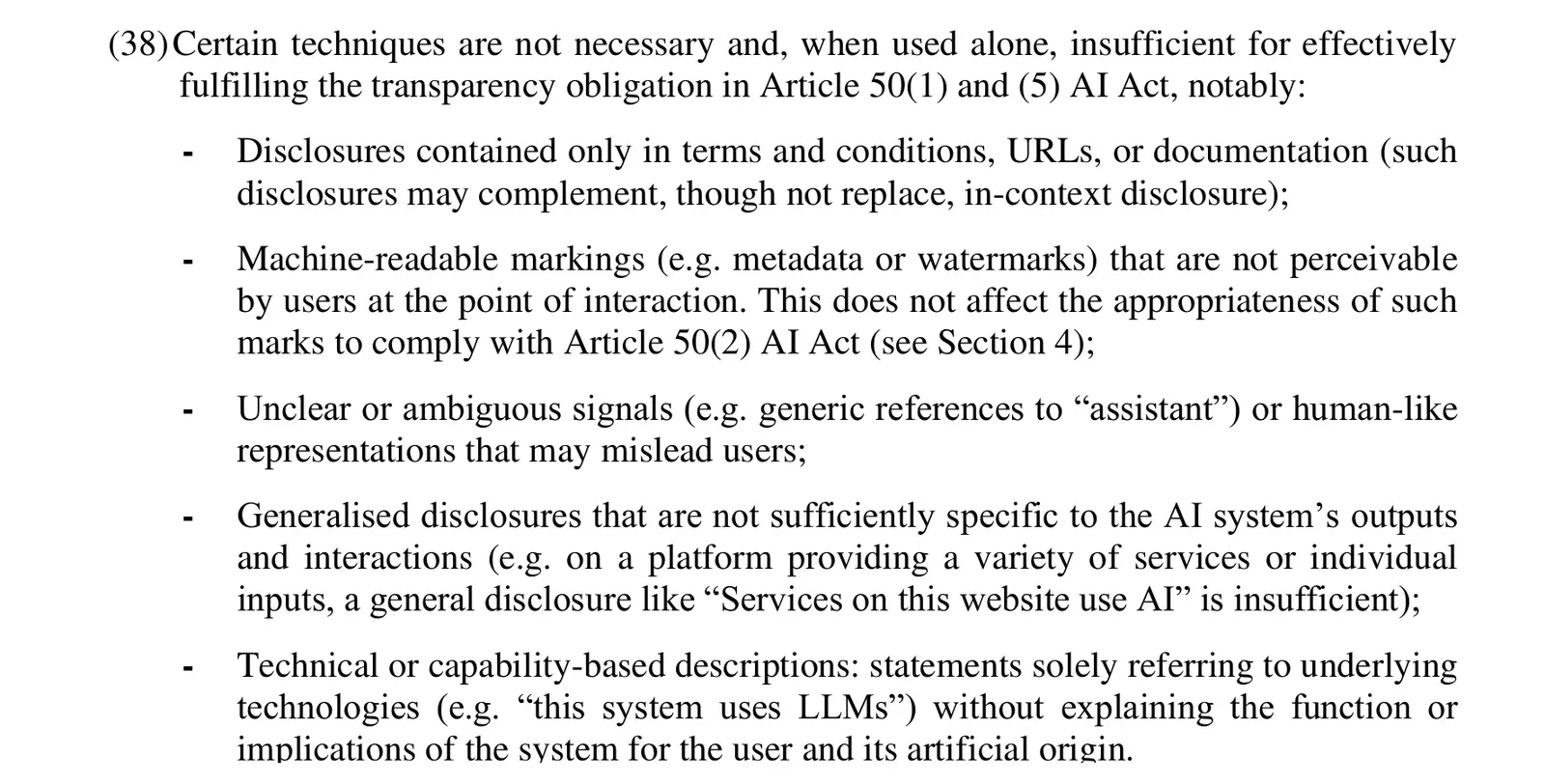
In sensitive areas such as financial advice, insurance, legal matters, health and complaints, the guidelines expect repeated notices. If a customer asks whether they are talking to a human, the system must answer honestly.
If you buy a ready-made chatbot, the vendor is usually the provider and must build in the notice. Still check that it is switched on and visible on your side. If you have a chatbot built for you and run it under your brand, you are the provider.
Step 3: Check whether an image, video or audio is a deepfake
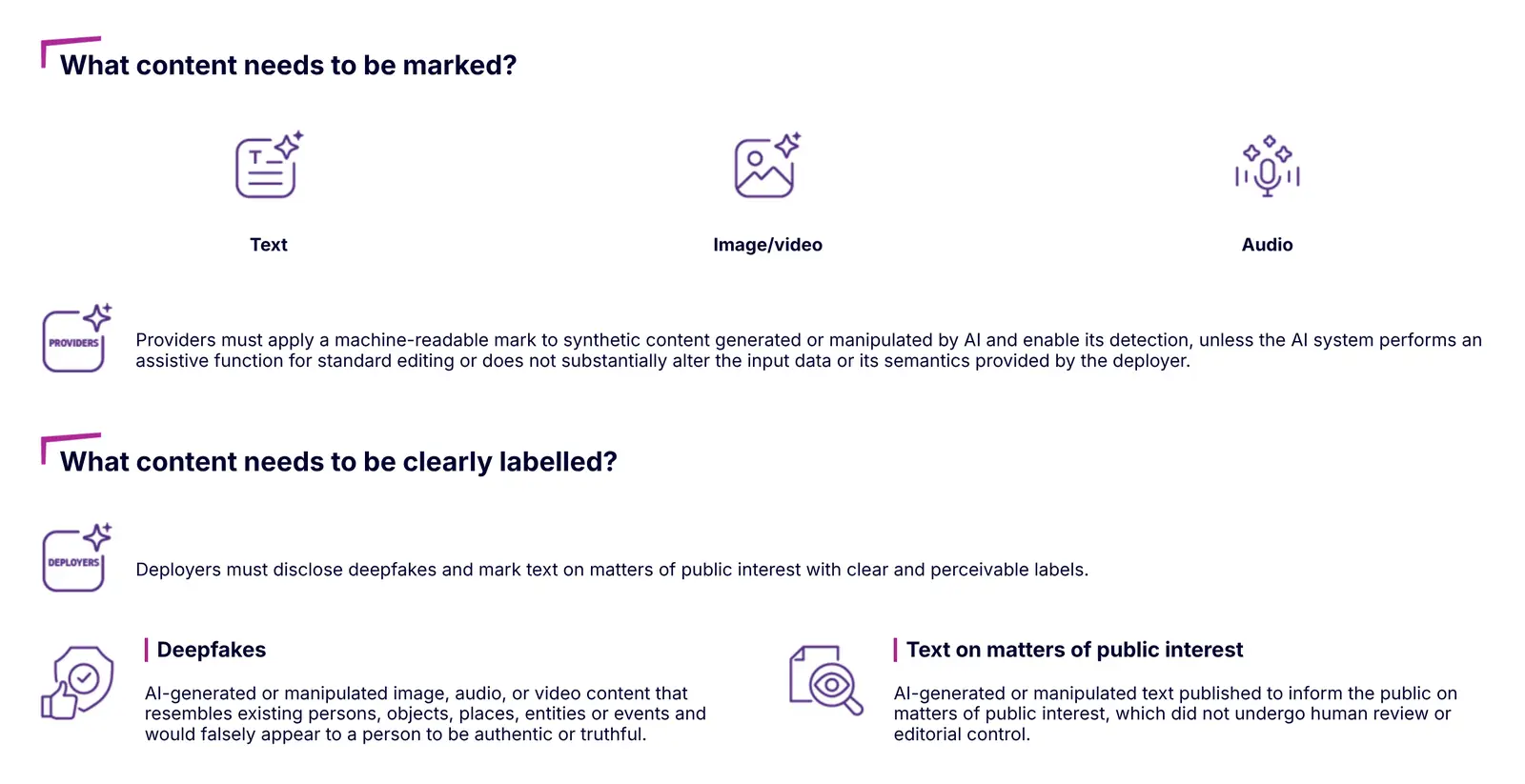
Under Article 3(60), a deepfake is AI-generated or manipulated image, audio or video content that resembles existing persons, objects, places, entities or events and would falsely appear authentic. Texts are not deepfakes. ALIA suggests five questions before publishing anything: generated or manipulated by AI? Image, audio or video? Does it show a person, object, place, event or entity? Could it really exist? Could it falsely appear authentic? If every answer is yes, it needs a notice.
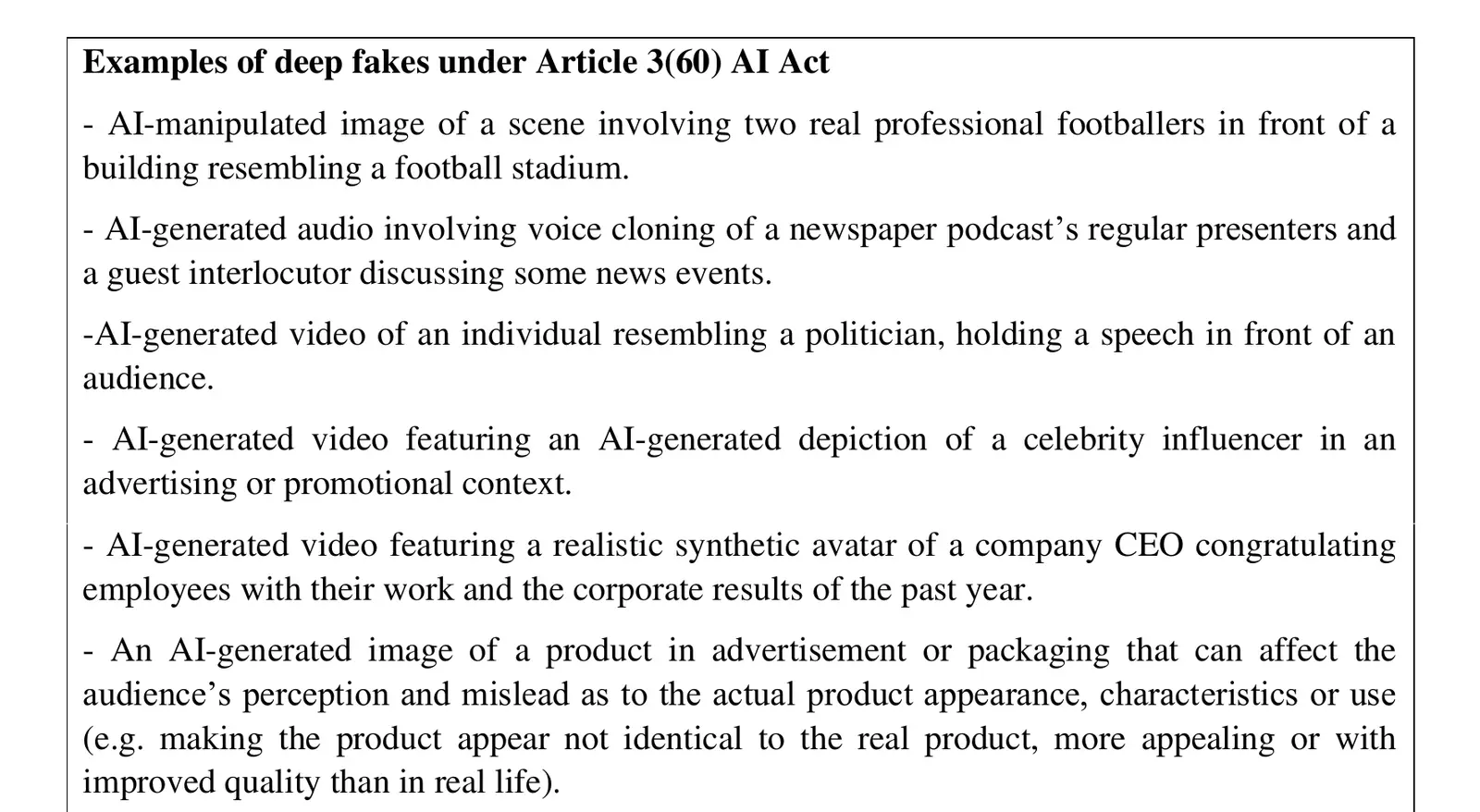
The guideline examples that matter most for companies:
- Deepfake: a realistic AI avatar of the CEO congratulating staff; an AI celebrity influencer in an ad; an AI product image that makes the product look better than it really is.
- Not a deepfake: talking mice in a cheese commercial; colour correction, lighting adjustments or a replaced background for purely aesthetic reasons; a real car against an AI landscape, as long as the ad does not mislead about the product.
Photorealism alone does not decide it. The audience counts: if content will foreseeably reach children or older people, it is enough that it looks real to them. A video only in a subscriber area or an internal newsletter does not have to be treated as if the whole public would see it.
Step 4: Art, satire, fiction need only a lighter notice
If a deepfake is part of an evidently artistic, creative, satirical or fictional work, a notice that does not hamper the work is enough, for example in the credits. It does not disappear entirely. "Evidently" means the audience must recognise it at once. Advertising qualifies only case by case, and where content also informs, full labelling applies. The guidelines give as counterexamples a teleshopping spot with synthetic customers and a realistic AI influencer testing a sponsored product. Third party rights such as data protection and copyright apply in any case.
Step 5: Label AI texts only on matters of public interest
Paragraph 4, second subparagraph, applies only when three things come together: the text is published, is meant to inform the public and concerns a matter of public interest, such as politics, health, the environment, consumer safety or economic developments.
- Notice needed if unreviewed: investor information on a listed company's website, a lifestyle article comparing diets for a disease, an AI summary of a newspaper article on a town council decision.
- No notice needed: ad copy and product descriptions, as long as they make no claims about health, consumer safety or sustainability; chatbot answers seen only by the user who asked; advice letters to a client.
The duty falls away if a human has reviewed the content and a person or company holds editorial responsibility. Review means at least a fact check. Spell-checking, an automated check or a cursory sign-off is not enough. The name or function of the responsible person should be easy to find publicly, for example in the website's legal information. If AI changes the substance of the text after sign-off, the exception no longer applies.
Step 6: What a good notice looks like
Article 50(5) requires notices to be clear, distinguishable, given at the latest at first contact and accessible. A notice that only appears in the terms of use or deep in a menu is not enough.
For deepfakes and texts, Section 2 of the code of practice spells out the form: an icon or label with the acronym "AI", placed in the content itself, for example top right in an image. For videos it appears at the start and preferably at regular intervals, for audio only there is a short spoken disclaimer at the start, and for texts a label above the text or next to the headline. For deepfakes used only for internal training, the notice may be placed beforehand in the interface or the physical setting. The EU icons are optional and free to use, but using them does not on its own make a notice compliant. ALIA gives as an example the line "Contenu généré par IA" below a post or poster.
This is how it can look in practice. The wording is our suggestion; the criteria come from the guidelines and the code:
| Channel | Situation | Possible notice |
|---|---|---|
| Website | Chatbot answers customer questions | Banner and first message: "You are chatting with an AI assistant from [company]. To reach a person, type: agent." |
| Phone | Voicebot takes orders | Announcement at the start: "You are speaking with an AI assistant." |
| Social media | AI video with a realistic avatar of your CEO | "AI" icon top right in the video, at the start and repeated, plus "AI-generated video" in the post text |
| Online shop | Photorealistic AI product image in a new setting | "AI-generated" label in the image itself, if the image could mislead about the product |
| Blog | Unreviewed AI text on energy prices | Label above the title: "This text was created with AI." |
| Podcast or radio ad | Cloned voice of a real person | short spoken notice at the start |
According to the guidelines, platforms such as Instagram or LinkedIn are not deployers just because they spread your content. The duty stays with you, even if the platform offers its own AI label.
Step 7: Sign the code or prove it yourself?
The Code of Practice on Transparency of AI-generated Content was published in its final version on 10.06.2026. The Commission assessed it as adequate on 08.07.2026, the AI Board on 09.07.2026 (Commission). It is voluntary and has two parts: Section 1 for providers, Section 2 for deployers. By the end of July 2026 about 190 organisations had signed, roughly half of them small and recent companies. The signatory page listed 103 signatories for Section 1 and 219 for Section 2 on 20.11.2026.
The guidelines were published on 20.07.2026. The version available today is Communication C(2026) 7702 of 05.11.2026 in all official languages. They are not binding; only the Court of Justice of the EU can give a binding interpretation.
For deployers that sign Section 2, authorities mainly check whether they apply the code. Those that do not sign must show in another way that their notices are adequate, for example with a gap analysis against the code, and should expect more requests for information. There is no code for chatbot disclosures (paragraph 1). There you choose the measures yourself, guided by the guidelines.
Step 8: Who supervises in Luxembourg?
The competent authorities will be set by Luxembourg bill No. 8476, which has not yet been passed. On the Chamber of Deputies website it was still listed as "En commission" on 20.11.2026, last updated on 10.07.2026.
- According to ALIA, the media regulator ALIA is to become the market surveillance authority for Article 50(2) and (4), that is marking, deepfakes and AI texts, and only for professional use such as advertising campaigns.
- According to the CNPD, the CNPD is to become the market surveillance authority for all cases not assigned elsewhere and the single point of contact. The EU list of contact points names the CNPD for Luxembourg, noting that the national decision is still pending.
- ILNAS follows AI standardisation through the national committee ILNAS/NSC 04. We found no supervisory role for ILNAS under Article 50.
Breaches of Article 50 can cost up to 15 million EUR or 3 % of worldwide annual turnover (Article 99(4)(g)). For SMEs the lower of the two amounts is the ceiling (paragraph 6). Consumer law and the GDPR apply on top: if AI is a main characteristic of a service, it may have to be disclosed before the contract is concluded.
Checklist: labelling AI content correctly
- List every customer-facing AI use: chatbots, voicebots, agents, image, video, audio and text tools.
- Clarify the role for each: provider (own development under your brand) or deployer (using someone else's tool).
- Chatbot and voicebot: visible or spoken AI notice at first contact, an honest answer to "Am I talking to a human?".
- Ask your tool providers whether outputs will be machine-readably marked from 02.12.2026.
- Before publishing AI images, videos and audio, answer ALIA's five deepfake questions.
- Label deepfakes with an "AI" icon or label in the content itself, at the start and repeated for video, spoken for audio.
- Either label AI texts on matters of public interest or have them reviewed by a person and name the responsible function in your legal information.
- Still label creative and satirical content discreetly, for example in the credits.
- Write the rule down, train your team and agencies, document examples.
- Decide whether to sign Section 2 of the code of practice or keep your own evidence.
What is still open
- Bill No. 8476 has not been passed. Whether ALIA, the CNPD or a sector regulator is competent in a given case will only be settled by the law.
- An EU-wide audio solution for deepfakes is still to be developed by a task force under the code.
- The guidelines are a first interpretation. The Commission plans to review them as experience from practice, market surveillance and CJEU rulings comes in.
Questions and answers
Do I have to label every ad text written with AI?
Is there a transitional period for existing chatbots?
Do I have to label old AI images retroactively?
Are the EU icons enough as a label?
Sources
- [1] AI Act, Article 50: Transparency obligations for providers and deployers of certain AI systems, AI Act Service Desk (consolidated text) accessed 2026-11-20
- [2] AI Act, Article 3: Definitions, AI Act Service Desk accessed 2026-11-20
- [3] AI Act, Article 113: Entry into force and application, AI Act Service Desk accessed 2026-11-20
- [4] AI Act, Article 111: AI systems already placed on the market or put into service, AI Act Service Desk accessed 2026-11-20
- [5] AI Act, Article 99: Penalties, AI Act Service Desk accessed 2026-11-20
- [6] Regulation (EU) 2026/1744 of 08.07.2026 amending Regulation (EU) 2024/1689 (Digital Omnibus on AI), OJ L, 24.07.2026 accessed 2026-11-20
- [7] Commission Guidelines on the transparency obligations for providers and deployers of AI systems under Article 50 AI Act, C(2026) 7702 final (05.11.2026) accessed 2026-11-20
- [8] Guidelines on AI transparency obligations, overview page, European Commission (updated 06.08.2026) accessed 2026-11-20
- [9] Quick Facts: Transparency rules for AI systems, European Commission (updated 29.07.2026) accessed 2026-11-20
- [10] FAQ: Transparency obligations under Article 50 AI Act, European Commission (24.07.2026) accessed 2026-11-20
- [11] Code of Practice on Transparency of AI-generated Content, European Commission (updated 19.10.2026) accessed 2026-11-20
- [12] Commission publishes final Code of Practice on transparency of AI-generated content, press release IP/26/1328 (10.06.2026) accessed 2026-11-20
- [13] Commission opinion on the assessment of the Code of Practice on Transparency of AI-generated Content (08.07.2026) accessed 2026-11-20
- [14] Strong backing for the Code of Practice on Transparency of AI-generated Content, signatories, European Commission (updated 18.11.2026) accessed 2026-11-20
- [15] FAQ: Signing the Code of Practice on Transparency of AI-generated Content, European Commission accessed 2026-11-20
- [16] EU icons for labelling AI-generated content, European Commission (updated 13.10.2026) accessed 2026-11-20
- [17] Market surveillance authorities under the AI Act, European Commission (updated 09.11.2026) accessed 2026-11-20
- [18] Deepfakes et transparence : obligations pour les déployeurs, ALIA accessed 2026-11-20
- [19] Intelligence artificielle (IA), ALIA accessed 2026-11-20
- [20] AI Act : un an après, CNPD (18.08.2025) accessed 2026-11-20
- [21] Projet de loi 8476, Chambre des Députés accessed 2026-11-20
- [22] Artificial Intelligence, Portail Qualité, ILNAS accessed 2026-11-20
- [23] Legal notice, Shaping Europe's digital future, European Commission accessed 2026-11-20